In these brief videos, David Powlison answer questions about idolatry.

In these brief videos, David Powlison answer questions about idolatry.
Is the tithe valid today, in the new covenant? Does God require it of Christians such that anything short of this amount is robbing God? Drs. Andres Kostenberger and David Croteau, professors of Biblical Studies at Liberty University, answer these questions with a resounding ‘No’ in their article titled Tithing in the Old and New Testaments. They argue that none of the three New Testament passages that reference tithing (Matthew 23:23, Luke 18:9-14, Hebrews 7:1-10) support a continuation of the practice because the passages neither having tithing as their primary subject, nor command tithing for Christians.
In a second article, A Biblical Model for Giving, they explain their view of New Testament giving. The view can be summarized in three points based on the texts 1 Corinthians 16:1-2, 2 Corinthians 8:2-4, 8-9; 9:6-7; Philippians 4:16-18:
See table 1 in the article for further detail. The professors’ view is that our obedience in giving should be based on our love for God in gratitude for what He’s given us such that we should be willing to give whatever He asks of us rather than just focusing on a prescribed amount (10%). Giving will test and grow our faith and we should manage our life so that we can give more.
You can hear a discussion of the topic of tithing with Croteau and Chuck Bentley of Crown Financial Ministries on Moody’s Up for Debate. If you want to study the topic further, Croteau goes into much greater detail in his dissertation titled Toward a Theology of Giving in the New Covenant. He also lists the six best arguments for the tithe on his blog.
If you’re wondering where other pastors land on this topic here’s a list with links to their explanations. As you’ll see the issue isn’t black and white:
For tithing:
Against tithing:
The book Perspectives on Tithing – Four Views also captures the spectrum of opinions on the topic.
In the article A Puritan Approach to Worship, JI Packer describes the nature of Puritan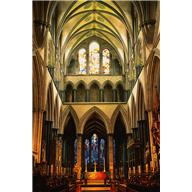 worship and their principles of practicing it. He defines worship as doxology, a giving of glory, praise, honor, and homage to God, but more expansively, all true piety (godliness) is worship. For the Puritans, the practice of worship includes praise, prayer, preaching, the sacraments, catechizing and the exercise of church discipline. It encompasses three spheres of life: public, in the local church; domestic, in the family circle; private, in the closet. Packer quotes John Owen, Stephen Charnock and George Swinnock on the topic with the last quote capturing his recommendation for how to improve modern day worship:
 Here is the beginning of the list of John Piper books that are available for free in various formats (but mostly pdf):
The Completeness of God’s Forgiveness captures a list of word pictures that describe our standing before God because of the work of Christ. The list is below and worth praying through in thankfulness to God. The article provides details and verse references.
Check out this fishless fisherman evangelism cartoon illustration:
The following passages are from the book The Purpose of Man: Designed for Worship by AW Tozer. They capture Tozer’s thoughts on worship, but some have been edited for continuity between the sections:
Everything in God’s creation has its purpose. God created the silkworm to make silk; the bird was created to sing; the sheep for their wool. Throughout the Bible, the prophets and apostles all testify that God made us for a purpose and that purpose is to sing His praises before the hushed audience of all creation…
The purpose of nature is to lead us to the Creator and to worship Him. The purpose of man’s feelings and emotions is to lead to the One who implanted those within the heart of man, to the Creator. Everything in all of creation is to point to the Creator and evoke within adoring wonder and admiration and worship. Wherever we go, we can worship.
Jesus taught essentially that we are portable sanctuaries, and if we are worshiping in spirit and truth, we can take our sanctuary around with us. Jesus said, “Don’t you see that if God is Spirit, worship is spiritual, and anything spiritual has no location in space and it has no location in time?” You do not get up in the morning, look at your calendar and say this is the time to worship. You do not get up, go out, look around and say, this is the place to worship. You worship God now, anywhere, any place, any time, because worship is spiritual…
When God made the human soul in His own image, He did so that we might act according to that Divine nature. He never intended the virus of sin to infect that sacred place within man. Sin, therefore, is the unnatural thing. It is a foreign substance defiling man’s heart and life, repelling God’s gaze. Because of this [fallen] condition in man, sin is [now] natural, worship is unnatural; and so few people really do it.
Because of this, it is important to understand that nobody can devise their own pattern of worship or worship God any way they please. The pleasure here belongs to God alone. The One who created us to worship Him also has decreed how we shall worship Him. We cannot worship God as we will; our worship must always confirm to God’s pleasure. God does not accept just any kind of worship. He accepts worship only when it is pure and when it flows from a heart under the afflatus (inspiration) of the Holy Spirit. Only such worship, compatible with His holy nature, can possibly be accepted by Him.
It is a favorite ploy of the devil and a favorite pet of unconverted poets to suggest that we just worship God any way we want to worship and at our whim, and all will be well, as long as we are sincere. This deception destroys the lives of multitudes of people in every generation….
It is entirely possible to have a religious experience without God, and even reject the God of the Bible. It is possible to have an experience of worship, but not according to the will of God and, consequently, unacceptable with God, because God hates idolatry. Idolatry is simply worship directed in any direction but God’s, which is the epitome of blasphemy…
Thomas Boston said the difference between man and beast is that a beast looks down and a man is made to look up. Only man can engage the God above…God is infinitely more concerned that He has worshipers than that He has workers….I think we should work for the Lord, but it is a matter of grace on God’s part. However, I do not think we should ever work until we learn to worship. A worshiper can work with eternal quality in his work, but a worker who does not worship is only piling up wood, hay and stubble for the time when God sets the world on fire. God wants worshipers before He wants workers. He calls us back to that for which we were created – to worship the Lord God and to enjoy Him forever. And then out of our deep worship flows our work for Him. Our work is only acceptable to God if our worship is acceptable…
I believe that we are saved by faith in the Son of God as Lord and Savior. But what concerns me is an automatic quality about being saved nowadays. It works something like this: simply put a nickel of faith in the slot, pull down a lever and take out the little coin of salvation, tuck it in your pocket and off you go. It is that simple. After that, you say you are saved. When questioned, you simply say, “I put the nickel in; I accepted Jesus and I signed the card.”…Christianity is not a result of coming to God and becoming an automatic cookie-cutter Christian, stamped out with a die: “One size fits all”; “What God has done for others He’ll do for you.” These are marvelous mottos with a grain of truth in them but they lead us far from the absolute truth. We come to Christ so that we might be individually redeemed and made in the image of Christ – vibrant, personal Christians who love God with all our heart and worship Him in the beauty of holiness…
Worship is to feel in the heart and express in some appropriate manner a humbling but delightful sense of admiring awe. Worship will humble a person as nothing else can because there must be humility in the heart before there can be worship…
When the Holy Spirit comes and opens heaven until people stand astonished at what they see, and in astonished wonderment confess His uncreated loveliness in the presence of that most ancient mystery, then you have worship. If it is not mysterious, there can be no worship; if I can understand God, then I cannot worship God. I will never get on my knees and say, “Holy, holy, holy” to that which I can figure out. That which I can explain will never overawe me, never fill me with astonishment, wonder or admiration….
One of the greatest Bible teachers of his generation, Dr. D. Watson, talked often about the love we have for God. He taught two kinds of love: the love of gratitude and the love of excellence. We could love God because we are grateful to Him or we could go on past that and love God because of what He is. It is possible for a child to love his father or mother out of gratitude, which is proper and right; he should, of course. Years later, when he gets to know his parents, or maybe after they are gone, he will remember that he loved them also out of the love of excellence.
Some people we are supposed to love but there is no excellence there. You have to love them with infused love; you cannot love them with a love called out by their excellence. God Almighty is excellent, beyond all other beings. He is excellent; and so this love of excellence surpasses the love of gratitude. God’s children rarely get beyond the love they have for Him because He has been good to them. You rarely hear anybody praying in admiration of God and worshiping the excellence of God and talking to God about His own excellence. The psalms do his; Christ did this; and the apostles did, but we do not hear it much now. This generation has produced Christians that are primarily Santa Claus Christians. They eagerly look for God to put up a Christmas tree with all their gifts under it. They are grateful to God, and it is right and proper to be thankful for all things that He does for us and all the good, large and small. Hat He gives us. That is, however, only the lower, elementary kind of love.
Going beyond that comes the love of excellence where you can go into the presence of God and not want to rush out again, but stay in the presence of God, because you are in the presence of utter, infinite excellence. Naturally, you admire this, and this knowledge can grow until your heart has been I lifted into the excellency of love and admiration….
Honest must be in all our prayers distance from mere propriety. There must be complete honesty before God. If I get on my knees and pray, “Oh, Lord, meet our missionary budget,” and then the Lord knows that I am not going to give anything toward it. He knows that I am praying dishonestly.
If I pray, “Oh, Lord, save this man,” but I have never done anything toward winning him, I’m dishonest. If I ask God to do things that I could do for myself, I am dishonest in my graying. But we have glossed this over until it sounds shocking to hear it said. It is true nevertheless….
What is the purpose of the local church? And why is the church necessary?
According to the Bible, a local church exists to do corporately what each Christian should do individually all week: namely, worship God and show forth the excellencies of Him who has called us out of darkness into His marvelous light; reflect back the glory of Him who shined down on us, even God, even Christ, even the Holy Ghost. All that Christ has done for us in the past and all that He is doing now leads to this one end. This is not being taught very much today—that we are saved to worship God. We have it that we are saved for a number of reasons.
If you were to ask the average Christian why he was saved, he might respond by referring to peace of mind or being delivered from smoking. If he is a businessman, he might say he took the Lord Jesus as his helper because he was failing in business and wanted Him to be his business partner. We have many other reasons, and I am not going to be too hard on people. In the New Testament, people came to the Lord for many reasons. One man came because his boy was sick. A woman came because her daughter was sick. Another woman came because she had had a chronic disease for 12 years. A politician climbed a tree and looked down because his heart ached; and Nicodemus came by night to the Lord because his religion was not adequate and his heart was empty. Therefore, the Lord received them all, and the Lord receives everyone who comes to Him in faith today, even if their motives may not be the highest.
The point is, why should we always stay where we began? Why should the church be a spiritual school composed of first-graders who never go beyond the first grade? Nobody wants to get any further than this, and I do not mind saying that I am somewhat sick about it all. It seems to be an awful, mixed-up concept of Christianity.
The Lord Jesus Christ died on the cross that He might make His people worshipers of God. That is why we were born, that we might show forth the excellencies of Him who has called us out of darkness into His marvelous light. “He is your Lord, worship Him.” And we see that purpose-worship—when it is all over and the consummation has taken place and been fulfilled The beasts, the elders and the creatures under the sea, above the earth, in the earth, and in the heavens are all crying aloud. “Holy, holy, holy to the Lord God Almighty, which was, and is. And is to come.” The purpose of God is that He might redeem us, (to restore us again to the divine imperative of worship), to put us all in the heavenly choir and keep us there singing His praises and showing forth His excellencies while the ages roll. This is the purpose of God in redemption.
This video is a powerful portrait of the Gospel including breaking the law, the need for atonement, sacrifice and faith. It’s worth your time to watch.
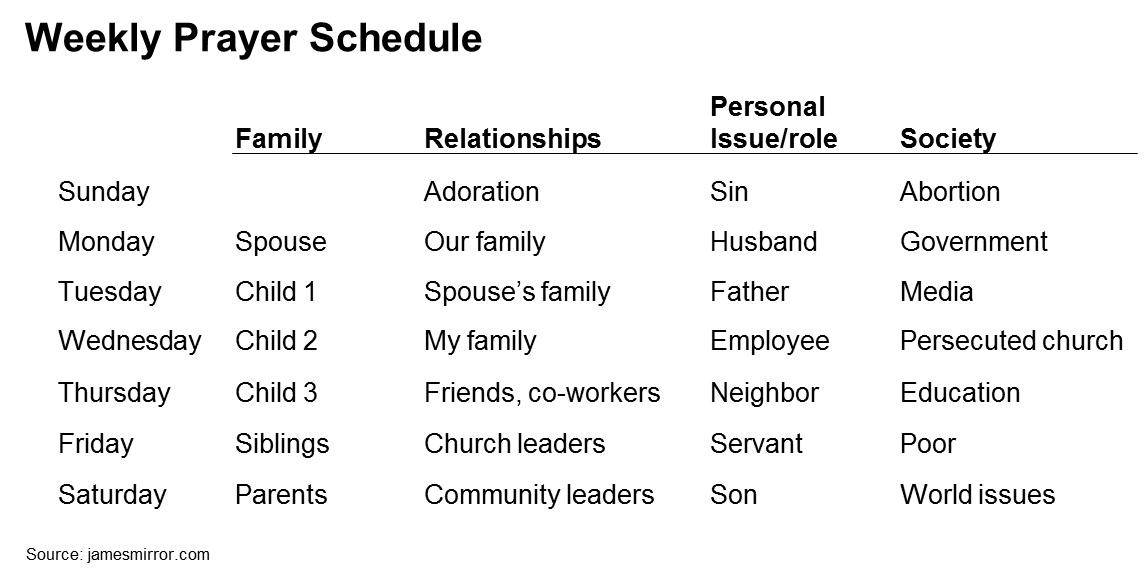
Struggle with prayer? As you think about how to improve your prayer life, consider a weekly schedule to improve your consistency and focus. Here’s a basic framework to give you some ideas. Each night pray for the following:
This schedule is heavily focused on requests, but the prayer should start by praising God for who He is, thanking Him for what He’s done and confessing sin. In the schedule, Sunday is focused on adoration of God and confession of sin be humble before God in preparation for the week ahead, but don’t limit those parts of prayer to only one day per week.
In his article, Why Children Need Father-Love and Mother-Love, Glenn Stanton summarizes how mothers and fathers parent differently and why children need both parents to mature in a balance manner. His points are as follow:
His conclusion
To be concerned with proper children development is to be concerned about making sure that children have daily access to the different and complementary ways mothers and fathers parent. The same-sex marriage and parenting proposition says this doesn’t really matter. They are wrong and their lack of understanding will hurt children. It will rob children of the necessary and different experiences mothers and fathers expose children to. As a result, children growing up in mother-only or father-only homes will suffer deeply in terms of lack of confidence, independence, and security. Boys and girls will be at greater risk for gender confusion, abuse and exploitation from other men. They are less likely to have a healthy respect for both women and men as they grow into adulthood.

 James' Mirror - Christian Discipleship Guide